Retrospective templates
Browse all our free agile retrospective templates. Pick a format, invite your team and run your next sprint retrospective in a few clicks.
Our latest ready-to-use retrospectives
No more starting from scratch: add, invite and start your retrospective!
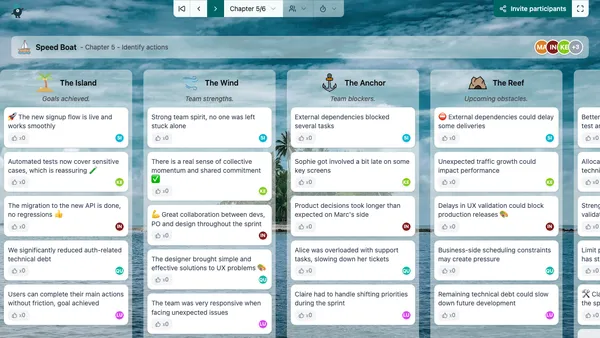

Speed Boat
One of the most popular retrospective formats. First published by Luke Hofmann in 2006 with the book Innovation Games: Creating Breakthrough Products Through Collaborative Play.
**Speed Boat** is one of the most popular and widely used retrospective formats in the agile world. First published by Luke Hohmann in 2006 in his book *Innovation Games: Creating Breakthrough Products Through Collaborative Play*, it uses a powerful nautical metaphor to guide team reflection. Imagine your team as a speed boat sailing toward an island destination. Various forces help or hinder your journey: - **The Island** 🏝️: Your goals and objectives. What did the team achieve? What destination milestones were reached? - **The Wind** 💨: Your strengths and tailwinds. What propelled the team forward? Practices, tools, or factors that accelerated progress. - **The Anchor** ⚓: Your blockers and drag. What slowed the team down? Obstacles, technical debt, or processes that acted as dead weight. - **The Reef** 🪸: Upcoming risks and dangers. What hazards lie ahead? Potential problems that could damage the team's progress if not addressed. The visual metaphor of Speed Boat makes it immediately intuitive: everyone understands the concepts of wind (helping forces), anchors (hindering forces), and reefs (risks). This accessibility makes it an excellent choice for teams new to retrospectives. The format is also highly versatile - it works equally well for sprint retrospectives, project retrospectives, or even product strategy sessions. The session ends with concrete actions to cut the anchors, navigate around the reefs, and harness the wind.
Discover this template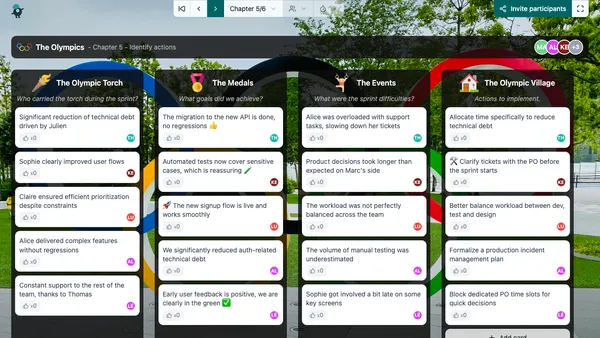

The Olympics
An ideal retrospective during the Summer or Winter Olympics. In this format, participants will use Olympic symbols to identify new improvement areas.
**The Olympics** is an immersive retrospective format that uses the symbols of the Olympic Games to help teams identify improvement areas in an engaging way. Whether it's the Summer or Winter Games, this format brings the Olympic spirit to your retrospective: - **The Olympic Torch** 🔥: Who carried the torch during the sprint? Recognize team members or practices that lit the way, inspired others, and kept the team's momentum going. - **The Medals** 🥇: What goals did we achieve? Celebrate the sprint's victories - completed features, resolved bugs, or milestones reached. - **The Events** 🏋️: What were the sprint difficulties? Like challenging athletic events, what tested the team's limits and required extra effort? Finally, **The Olympic Village** 🏘️ is where the team comes together to define actions to implement - the training plan for the next competition. This format excels at creating a positive and celebratory atmosphere while still addressing challenges. The Olympic metaphor naturally encourages recognition of individual and team achievements, making it ideal for teams that need a morale boost. Perfect for use during the actual Olympic Games or whenever the team wants a format that celebrates excellence while planning for continuous improvement.
Discover this template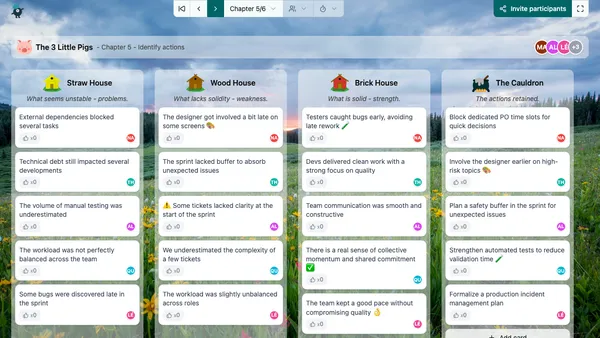

The 3 Little Pigs
Through the story of the 3 little pigs, participants will analyze the team's fundamentals to make them more solid.
**The 3 Little Pigs** retrospective uses the well-known fairy tale to help teams analyze and strengthen their fundamentals. Just like in the story, the team examines the solidity of their practices through three types of houses: - **Straw House** 🏚️: What seems unstable? The fragile elements - processes, tools, or practices that could collapse at the first sign of trouble. - **Wood House** 🏠: What lacks solidity? Things that work but aren't robust enough. They hold up under normal conditions but may not withstand pressure. - **Brick House** 🏰: What is solid? The team's strong foundations - practices, processes, and habits that are reliable and proven. Finally, **The Cauldron** 🍲 represents the actions the team will take to transform straw and wood elements into bricks. This storytelling approach makes the retrospective more engaging and helps team members think about the durability and reliability of their practices rather than just whether they "work" in the moment. The metaphor naturally encourages thinking about long-term resilience. The format is particularly effective for teams that want to assess the maturity of their processes or prepare for periods of increased workload where only the strongest practices will survive.
Discover this template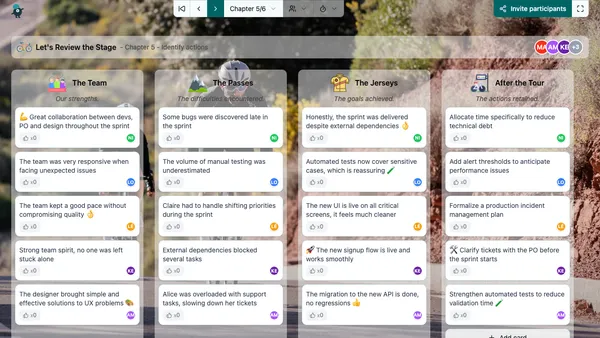

Let's Review the Stage
Cycling-themed retrospective. The team just crossed the finish line of today's stage (their sprint). It's time to take stock and prepare for the next stage.
**Let's Review the Stage** is a cycling-themed retrospective that draws on the excitement and strategy of the Tour de France. The team has just crossed the finish line of today's stage - their sprint - and it's time to analyze the race. Like a cycling team reviewing their performance after a grueling stage: - **The Team** 🚴: Our strengths. What did we do well as a team? What individual or collective performances stood out? - **The Passes** ⛰️: The difficulties encountered. Like climbing mountain passes, what challenges tested the team's endurance and determination? - **The Jerseys** 🏅: The goals achieved. Like earning a yellow, green, or polka-dot jersey, what objectives and milestones did the team accomplish? Finally, **After the Tour** 🎯 is where the team plans for the next stage - defining concrete actions and tactical adjustments for the upcoming sprint. This format works particularly well during the actual Tour de France or other cycling events, but its metaphor is accessible year-round. The concept of stages (sprints), mountain passes (challenges), and jerseys (achievements) maps naturally to agile development. The format encourages team solidarity - just like in cycling where the team works together to support their leader, this retrospective emphasizes collective performance and mutual support as keys to success.
Discover this template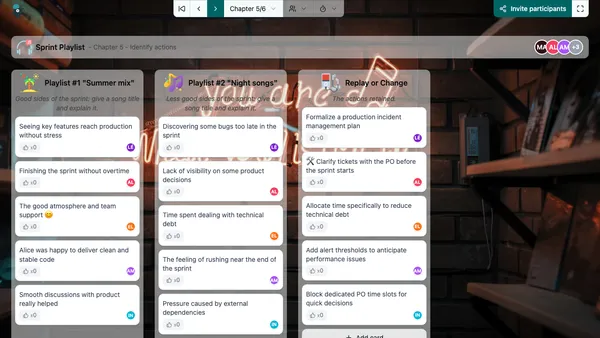

Sprint Playlist
In this original retrospective, participants will create the sprint's playlist. An ideal format to animate summer retrospectives.
**Sprint Playlist** is an original and creative retrospective format where participants compose the soundtrack of their sprint. The concept is simple and fun: for each topic, participants give a song title and explain why they chose it. This creative constraint helps people express complex feelings in an engaging and often humorous way. - **Playlist #1 "Summer Mix"** 🎵: The good sides of the sprint. What would be on the feel-good playlist? Give a song title that represents something positive and explain the connection. - **Playlist #2 "Night Songs"** 🌙: The less good sides of the sprint. What would be on the melancholic playlist? Give a song title that captures a challenge or frustration and explain why. After sharing and voting on the most impactful topics, the team decides together: **Replay or Change?** 🔄 - defining concrete actions for the next sprint. This format is ideal for summer retrospectives or for teams looking to inject creativity and fun into their reflection process. The musical metaphor breaks down barriers and encourages even quiet team members to participate in a playful way. It often produces memorable moments and inside jokes that strengthen team culture. No musical talent required - the goal is expression, not performance!
Discover this template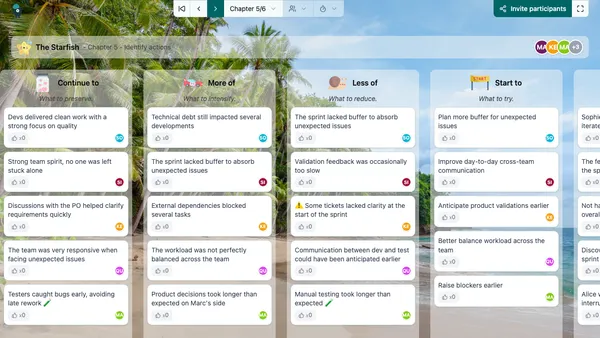

The Starfish
The starfish retrospective is based on the image of this marine animal with 5 arms, representing the 5 themes analyzed by participants during the workshop.
**The Starfish** retrospective is based on the image of a starfish with 5 arms, each representing one of the five themes explored during the workshop. Created by Patrick Kua, this format provides a nuanced and comprehensive framework for team reflection. The five dimensions are: - **Continue to** ➡️: What's working well and should be preserved as-is? Practices that the team is satisfied with. - **More of** ⬆️: What's good but should be intensified? Things that work but could have an even greater impact if done more frequently or more thoroughly. - **Less of** ⬇️: What should be reduced? Practices that aren't necessarily bad but are happening too much or consuming too many resources. - **Start to** 🆕: What should the team begin doing? New ideas, practices, or experiments to try. - **Stop doing** 🛑: What should be completely eliminated? Things that clearly don't work and waste time or energy. The key advantage of the Starfish format over simpler formats (like Start/Stop/Continue) is the addition of "More of" and "Less of." These nuanced categories acknowledge that not everything is black and white - some practices just need adjustment in intensity rather than being started or stopped entirely. This makes the Starfish particularly effective for mature teams that have been through several retrospectives and are ready for more subtle and refined analysis of their practices. The session concludes with voting and the definition of concrete actions across all five dimensions.
Discover this template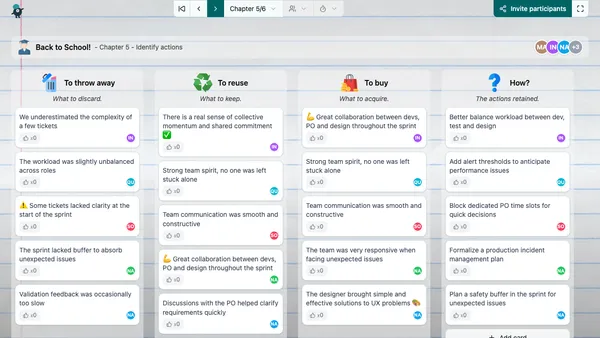

Back to School!
Back to school soon? This activity will help you clean up your business. Every student had a problem with back to school: we have to take inventory of our school affairs to check for those that are no longer working and that will be thrown away, those that work and that we want to keep and finally those that would be needed. buy.
**Back to School!** is an original retrospective format that uses the metaphor of preparing for a new school year to help teams take stock of their practices. Every student knows the ritual: before the new year begins, you need to sort through your school supplies. Some are worn out and need to be thrown away, others are still in good condition and can be reused, and finally, some new ones need to be purchased. This metaphor translates perfectly to a team context: - **To throw away** 🗑️: What practices, processes, or habits are no longer working and should be discarded? - **To reuse** ♻️: What's still working well and should be kept for the next sprint? - **To buy** 🛒: What new practices, tools, or approaches should we acquire and start using? The nostalgic and playful tone of this format makes it ideal for teams looking for a fresh perspective on their retrospective. It works particularly well at the start of a new project phase, after vacations, or when the team wants to do a thorough review of its working methods. The session concludes with the team defining concrete actions to implement the identified changes.
Discover this template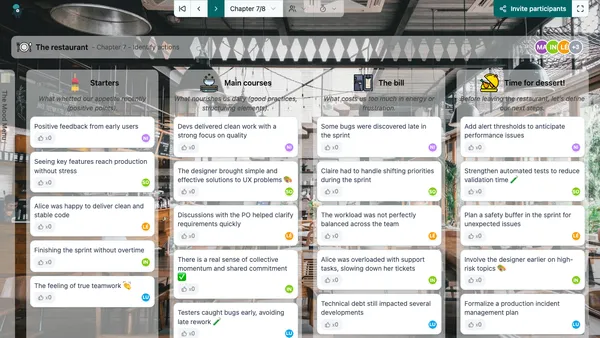

The restaurant
Take your team to the restaurant for a retrospective! In this original format, each participant starts by choosing the dish that represents their mood. Then, the team reflects on what whetted their appetite (positives), what nourishes them daily (good practices), and what costs too much (frustrations). Finally, before leaving the restaurant, everyone defines the next steps together.
**The Restaurant** is an original retrospective format that invites the team to dine together to reflect on their sprint. The session kicks off with an icebreaker called **The Mood Menu**, where each participant picks a dish that best represents their current state of mind - from the calm glass of wine to the fiery chili pepper. Then, the team explores the menu through themed columns: - **Starters** 🥗: What whetted our appetite recently? The positive moments and wins that energized the team. - **Main courses** 🍲: What nourishes us daily? The good practices, structuring elements, and routines that keep the team running smoothly. - **The bill** 💸: What costs us too much in energy or frustration? The pain points, inefficiencies, and recurring issues that drain the team. Finally, before leaving the restaurant, the team defines the **next steps** 🍰 - concrete actions to implement for the next sprint. This format is perfect for teams looking for a fun, relatable metaphor. Everyone has been to a restaurant, making it easy to engage with the themes. The icebreaker helps set a relaxed tone, and the food metaphor makes it natural to discuss both what nourishes the team and what leaves a bitter taste.
Discover this templateReady to run better sprint retrospectives?
Try Umbreon free for 7 days. No credit card, no commitment.
Start free trial