Retrospective templates
Browse all our free agile retrospective templates. Pick a format, invite your team and run your next sprint retrospective in a few clicks.
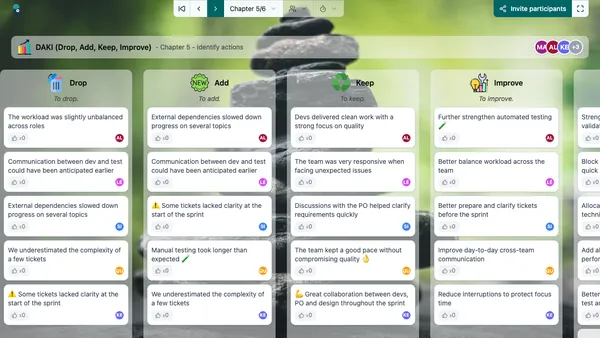

DAKI (Drop, Add, Keep, Improve)
DAKI is a classic retrospective format that fosters reflection on team practices and values. This format is recommended after the team has practiced scrum for several sprints. The team will then be better able to propose relevant changes.
**DAKI** (Drop, Add, Keep, Improve) is a classic retrospective format that provides a structured framework for teams to reflect on their practices and values. The acronym represents four distinct action-oriented categories: - **Drop**: What should the team stop doing? Practices, meetings, or processes that don't add value and consume time or energy. - **Add**: What should the team start doing? New ideas, tools, or practices that could benefit the team. - **Keep**: What is working well and should be preserved? Successful practices that the team wants to continue. - **Improve**: What existing practices could be enhanced? Things that work but could be made even better. This format is particularly recommended for teams that have been practicing Scrum for several sprints. At that point, the team has enough experience to propose relevant and meaningful changes rather than superficial adjustments. The distinction between "Drop" and "Improve" is what makes DAKI especially powerful: it forces the team to differentiate between things that should be eliminated entirely and things that just need refinement. Similarly, "Add" versus "Keep" helps distinguish between brand-new initiatives and existing successes. The session ends with a vote on the most impactful topics, followed by the creation of concrete action items for the next sprint.
Discover this template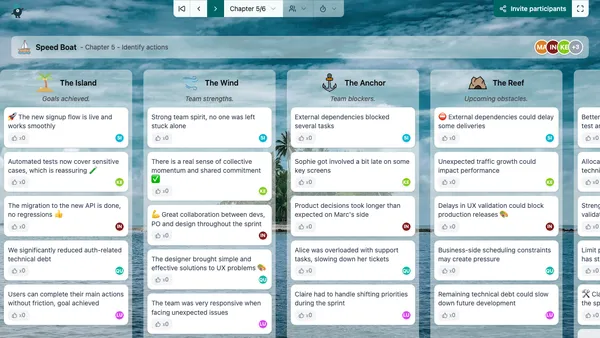

Speed Boat
One of the most popular retrospective formats. First published by Luke Hofmann in 2006 with the book Innovation Games: Creating Breakthrough Products Through Collaborative Play.
**Speed Boat** is one of the most popular and widely used retrospective formats in the agile world. First published by Luke Hohmann in 2006 in his book *Innovation Games: Creating Breakthrough Products Through Collaborative Play*, it uses a powerful nautical metaphor to guide team reflection. Imagine your team as a speed boat sailing toward an island destination. Various forces help or hinder your journey: - **The Island** 🏝️: Your goals and objectives. What did the team achieve? What destination milestones were reached? - **The Wind** 💨: Your strengths and tailwinds. What propelled the team forward? Practices, tools, or factors that accelerated progress. - **The Anchor** ⚓: Your blockers and drag. What slowed the team down? Obstacles, technical debt, or processes that acted as dead weight. - **The Reef** 🪸: Upcoming risks and dangers. What hazards lie ahead? Potential problems that could damage the team's progress if not addressed. The visual metaphor of Speed Boat makes it immediately intuitive: everyone understands the concepts of wind (helping forces), anchors (hindering forces), and reefs (risks). This accessibility makes it an excellent choice for teams new to retrospectives. The format is also highly versatile - it works equally well for sprint retrospectives, project retrospectives, or even product strategy sessions. The session ends with concrete actions to cut the anchors, navigate around the reefs, and harness the wind.
Discover this template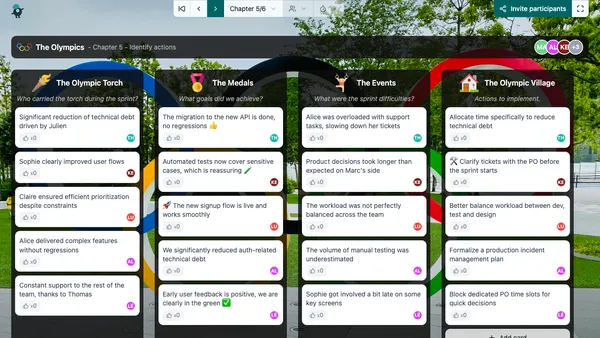

The Olympics
An ideal retrospective during the Summer or Winter Olympics. In this format, participants will use Olympic symbols to identify new improvement areas.
**The Olympics** is an immersive retrospective format that uses the symbols of the Olympic Games to help teams identify improvement areas in an engaging way. Whether it's the Summer or Winter Games, this format brings the Olympic spirit to your retrospective: - **The Olympic Torch** 🔥: Who carried the torch during the sprint? Recognize team members or practices that lit the way, inspired others, and kept the team's momentum going. - **The Medals** 🥇: What goals did we achieve? Celebrate the sprint's victories - completed features, resolved bugs, or milestones reached. - **The Events** 🏋️: What were the sprint difficulties? Like challenging athletic events, what tested the team's limits and required extra effort? Finally, **The Olympic Village** 🏘️ is where the team comes together to define actions to implement - the training plan for the next competition. This format excels at creating a positive and celebratory atmosphere while still addressing challenges. The Olympic metaphor naturally encourages recognition of individual and team achievements, making it ideal for teams that need a morale boost. Perfect for use during the actual Olympic Games or whenever the team wants a format that celebrates excellence while planning for continuous improvement.
Discover this template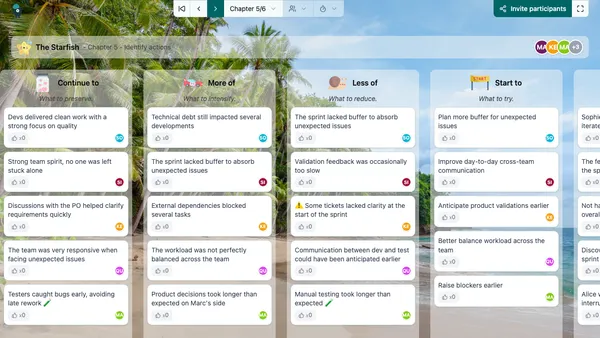

The Starfish
The starfish retrospective is based on the image of this marine animal with 5 arms, representing the 5 themes analyzed by participants during the workshop.
**The Starfish** retrospective is based on the image of a starfish with 5 arms, each representing one of the five themes explored during the workshop. Created by Patrick Kua, this format provides a nuanced and comprehensive framework for team reflection. The five dimensions are: - **Continue to** ➡️: What's working well and should be preserved as-is? Practices that the team is satisfied with. - **More of** ⬆️: What's good but should be intensified? Things that work but could have an even greater impact if done more frequently or more thoroughly. - **Less of** ⬇️: What should be reduced? Practices that aren't necessarily bad but are happening too much or consuming too many resources. - **Start to** 🆕: What should the team begin doing? New ideas, practices, or experiments to try. - **Stop doing** 🛑: What should be completely eliminated? Things that clearly don't work and waste time or energy. The key advantage of the Starfish format over simpler formats (like Start/Stop/Continue) is the addition of "More of" and "Less of." These nuanced categories acknowledge that not everything is black and white - some practices just need adjustment in intensity rather than being started or stopped entirely. This makes the Starfish particularly effective for mature teams that have been through several retrospectives and are ready for more subtle and refined analysis of their practices. The session concludes with voting and the definition of concrete actions across all five dimensions.
Discover this template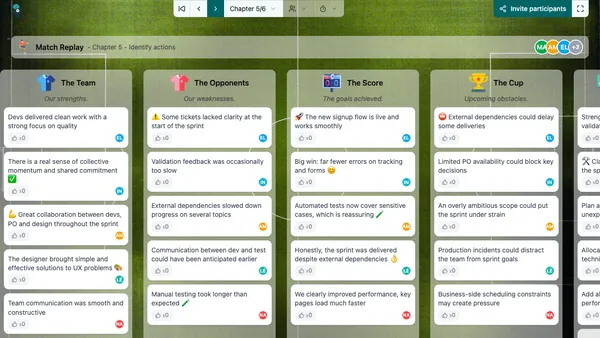

Match Replay
Football-themed retrospective. The match just ended. It's the perfect time for the team to reflect on its strengths and weaknesses to prepare for the next match.
**Match Replay** is a football-themed retrospective where the team analyzes their sprint as if they were reviewing a match that just ended. The whistle has blown, and it's time for the team to head to the analysis room and review their performance: - **The Team** ⚽: Our strengths. What did we do well? What plays worked and should be repeated? - **The Opponents** 🥅: Our weaknesses. What challenges did we face? What areas need improvement to compete better? - **The Score** 🏆: The goals achieved. What objectives did we accomplish during this sprint? - **The Cup** 🏅: Upcoming obstacles. What challenges await us in the next match (sprint)? Finally, **The Locker Room** 🚿 is where the team regroups and defines the actions to implement - the tactical adjustments for the next match. This format works particularly well for teams that enjoy sports analogies. The competitive metaphor naturally encourages team members to think about both individual and collective performance, strategy, and preparation. It's especially popular during major football events like the World Cup or European Championship. The format fosters a team spirit mindset: just like in football, success comes from collaboration, strategy, and continuous improvement.
Discover this template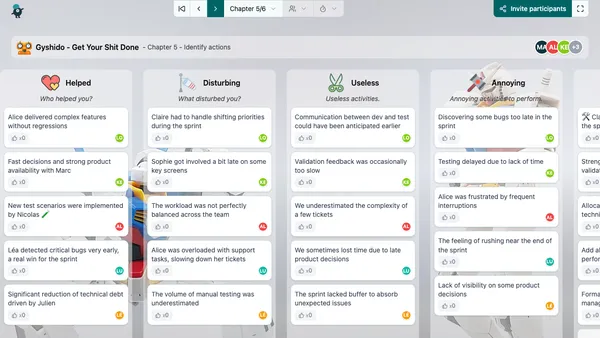

Gyshido - Get Your Shit Done
A retrospective originally inspired by the Gyshido movement: the art and way of simply getting things done by focusing on the essential.
**Gyshido - Get Your Shit Done** is a retrospective format inspired by the Gyshido movement: the art and way of simply getting things done by focusing on the essential. This format invites participants to look at their sprint through a pragmatic lens, focusing on what actually helps them move forward and what holds them back: - **Helped** 🤝: Who helped you during the sprint? Recognize the people, tools, or practices that made a positive difference. - **Disturbing** 😤: What disturbed you? Interruptions, unclear processes, or external factors that disrupted your focus. - **Useless** 🗑️: What activities felt useless? Meetings, processes, or tasks that consumed time without delivering value. - **Annoying** 😠: What was annoying to perform? Repetitive tasks, cumbersome processes, or friction points in your daily work. The strength of Gyshido lies in its direct and no-nonsense approach. Rather than focusing on abstract concepts, it encourages team members to be honest and specific about what helps and what hinders their ability to get things done. The session concludes with the team defining concrete actions to eliminate waste, reduce friction, and amplify what truly helps them deliver value.
Discover this template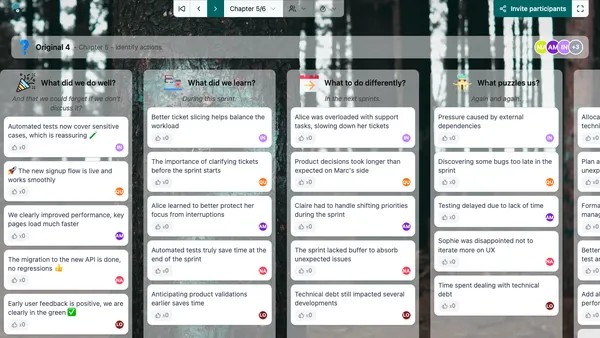

Original 4
Simple and accessible, this retrospective format revolves around the 4 questions that should be asked during a retrospective according to Norman Keth, considered by many to be the inventor of the retrospective.
The **Original 4** format is based on the four fundamental questions proposed by Norman Kerth, widely regarded as one of the pioneers of agile retrospectives. Published in his book *Project Retrospectives: A Handbook for Team Reviews* (2001), these questions form the foundation of many retrospective practices. The four questions are: - **What did we do well?** And that we might forget if we don't discuss it. This highlights positive practices worth preserving. - **What did we learn?** During this sprint. Knowledge gained through experience that the team should retain. - **What should we do differently?** In the next sprints. Concrete changes that could improve the team's effectiveness. - **What still puzzles us?** Questions or concerns that remain unresolved and deserve further investigation. This format is particularly valuable because it balances positive reflection with problem-solving. The fourth question - "What still puzzles us?" - is unique and powerful: it gives space for uncertainties and unanswered questions, encouraging curiosity rather than forcing premature conclusions. Ideal for teams at any maturity level, this format works well as a regular retrospective practice due to its simplicity and depth.
Discover this template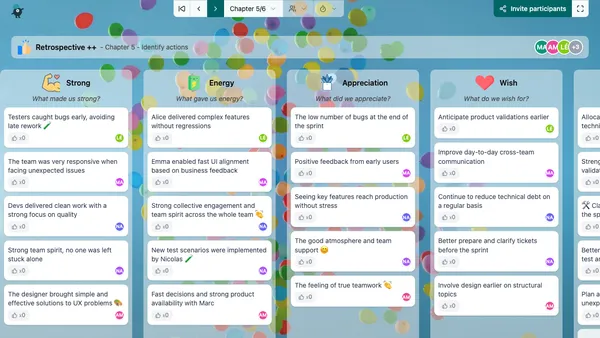

Retrospective ++
The team needs to be motivated and you want to focus on the positive aspects? This retrospective format is made for that!
**Retrospective ++** is a format designed to boost team morale by placing the spotlight firmly on positive aspects. When a team needs motivation and energy, this format delivers. The four columns are all framed positively, creating an uplifting atmosphere: - **Strong** 💪: What made us strong? The practices, decisions, or collaborations that gave the team its strength and resilience. - **Energy** ⚡: What gave us energy? The motivating factors - successes, fun moments, or breakthroughs that energized the team. - **Appreciation** 🙏: What did we appreciate? Recognition of people, support, tools, or circumstances that the team is grateful for. - **Wish** ✨: What do we wish for? Aspirations and hopes for the future - improvements or changes the team would like to see. The genius of this format is that even the improvement dimension ("Wish") is framed positively. Instead of focusing on problems, the team expresses desires and aspirations, which naturally leads to constructive and forward-looking action items. This format is particularly recommended when: - The team has gone through a difficult period and needs encouragement - Morale is low and traditional retrospectives feel too problem-focused - You want to reinforce positive team dynamics and celebrate achievements The session concludes with concrete actions that build on the team's strengths rather than just fixing weaknesses.
Discover this template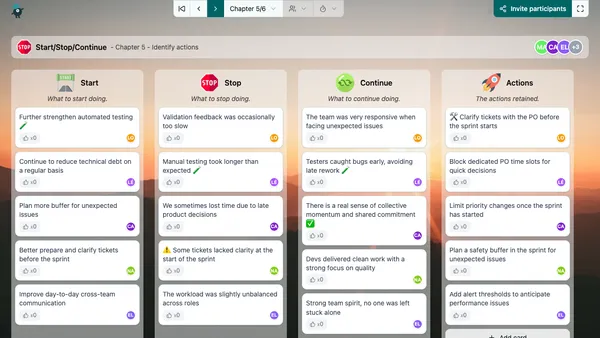

Start/Stop/Continue
This activity offers a very classic retrospective format which remains effective. Based on facts, this retrospective attempts to answer 3 questions: What should we start doing? What should we stop doing? What should we continue to do?
**Start/Stop/Continue** is one of the most classic and enduring retrospective formats in agile methodology. Its strength lies in its simplicity: three straightforward questions that any team can immediately understand and engage with. The format is based on facts and focuses on answering three essential questions: - **Start** 🟢: What should we start doing? New practices, processes, or behaviors that the team believes would be beneficial. - **Stop** 🔴: What should we stop doing? Activities, habits, or processes that aren't working, waste time, or create friction. - **Continue** 🔵: What should we continue doing? Practices that are working well and should be maintained. The beauty of Start/Stop/Continue is that it forces a balanced conversation: the team must identify both things to change and things to preserve. The "Continue" column is often underappreciated but is crucial - it ensures the team doesn't lose sight of what's already working while pursuing improvements. This format is particularly well-suited for: - Teams new to retrospectives, as it's immediately intuitive - Time-constrained sessions, as the structure keeps discussion focused - Regular sprint retrospectives where consistency and simplicity are valued Despite its simplicity, this format remains remarkably effective. The constraint of categorizing every insight into one of three actionable buckets naturally drives the conversation toward concrete outcomes rather than abstract discussion.
Discover this templateReady to run better sprint retrospectives?
Try Umbreon free for 7 days. No credit card, no commitment.
Start free trial