Retrospective templates
Browse all our free agile retrospective templates. Pick a format, invite your team and run your next sprint retrospective in a few clicks.
The unmissable retrospectives
If you want to stick to the classics and the unmissable, find here all our classic retrospective models with their detailed and guided steps.
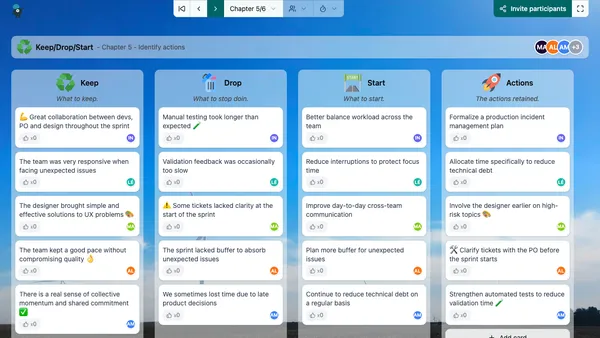

Keep/Drop/Start
In this classic retrospective format, participants must reflect on what to keep (keep), what to stop doing (drop) and what to start doing (start) for the next sprint.
The **Keep/Drop/Start** format is one of the most widely used retrospective formats in agile teams. Simple to set up and easy to understand, it invites each participant to reflect on three key questions: - **Keep**: What practices, habits, or actions worked well during the sprint and should be maintained? - **Drop**: What should we stop doing because it slows us down, creates frustration, or doesn't bring value? - **Start**: What new ideas or practices should we begin implementing to improve our way of working? This format is particularly effective because it provides a balanced view between positive reinforcement and constructive criticism. It encourages participants to not only identify problems but also recognize what's already working well. At the end of the reflection, the team votes on the most important topics and collaboratively defines concrete actions for the next sprint.
Discover this template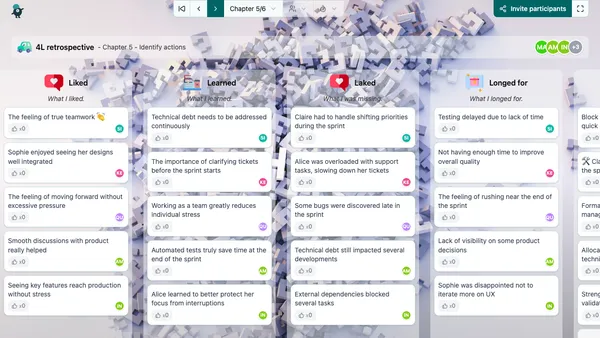

4L retrospective
The "4L" retrospective is a popular format that produces significant results for many teams. Here, 4 columns are displayed at the start of the activity and allow participants to reflect on what went well and what can be improved in the sprint.
The **4L Retrospective** is a popular and effective format that helps teams reflect on their sprint through four complementary dimensions, each starting with the letter L: - **Liked**: What did team members enjoy during the sprint? Positive experiences, successful collaborations, or satisfying achievements. - **Learned**: What new knowledge or skills did the team acquire? Lessons learned through successes or mistakes. - **Lacked**: What was missing? Resources, information, support, or tools that would have helped the team perform better. - **Longed for**: What does the team wish for? Aspirations, improvements, or changes they hope to see in the future. The strength of this format lies in its balanced approach. While "Liked" and "Learned" focus on positive reflection, "Lacked" and "Longed for" encourage the team to look forward and identify areas for growth without being overly negative. This format is particularly effective for teams that want to maintain a constructive and forward-looking atmosphere during their retrospectives. The four dimensions provide enough structure to guide the conversation while leaving room for open and honest discussion. After sharing their thoughts, the team votes on the most impactful topics and defines actionable improvements for the upcoming sprint.
Discover this template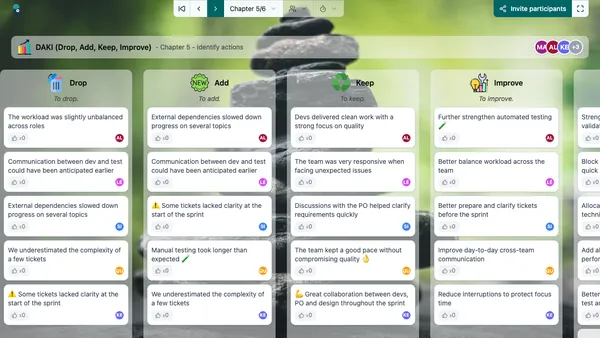

DAKI (Drop, Add, Keep, Improve)
DAKI is a classic retrospective format that fosters reflection on team practices and values. This format is recommended after the team has practiced scrum for several sprints. The team will then be better able to propose relevant changes.
**DAKI** (Drop, Add, Keep, Improve) is a classic retrospective format that provides a structured framework for teams to reflect on their practices and values. The acronym represents four distinct action-oriented categories: - **Drop**: What should the team stop doing? Practices, meetings, or processes that don't add value and consume time or energy. - **Add**: What should the team start doing? New ideas, tools, or practices that could benefit the team. - **Keep**: What is working well and should be preserved? Successful practices that the team wants to continue. - **Improve**: What existing practices could be enhanced? Things that work but could be made even better. This format is particularly recommended for teams that have been practicing Scrum for several sprints. At that point, the team has enough experience to propose relevant and meaningful changes rather than superficial adjustments. The distinction between "Drop" and "Improve" is what makes DAKI especially powerful: it forces the team to differentiate between things that should be eliminated entirely and things that just need refinement. Similarly, "Add" versus "Keep" helps distinguish between brand-new initiatives and existing successes. The session ends with a vote on the most impactful topics, followed by the creation of concrete action items for the next sprint.
Discover this template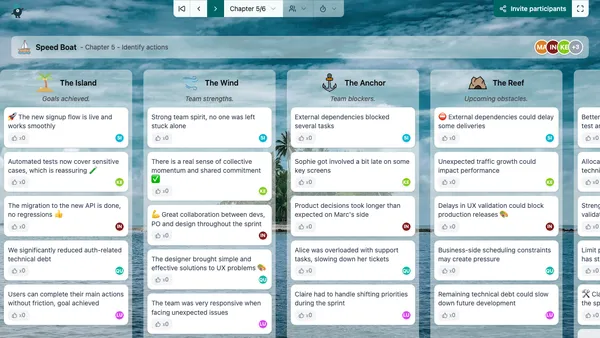

Speed Boat
One of the most popular retrospective formats. First published by Luke Hofmann in 2006 with the book Innovation Games: Creating Breakthrough Products Through Collaborative Play.
**Speed Boat** is one of the most popular and widely used retrospective formats in the agile world. First published by Luke Hohmann in 2006 in his book *Innovation Games: Creating Breakthrough Products Through Collaborative Play*, it uses a powerful nautical metaphor to guide team reflection. Imagine your team as a speed boat sailing toward an island destination. Various forces help or hinder your journey: - **The Island** 🏝️: Your goals and objectives. What did the team achieve? What destination milestones were reached? - **The Wind** 💨: Your strengths and tailwinds. What propelled the team forward? Practices, tools, or factors that accelerated progress. - **The Anchor** ⚓: Your blockers and drag. What slowed the team down? Obstacles, technical debt, or processes that acted as dead weight. - **The Reef** 🪸: Upcoming risks and dangers. What hazards lie ahead? Potential problems that could damage the team's progress if not addressed. The visual metaphor of Speed Boat makes it immediately intuitive: everyone understands the concepts of wind (helping forces), anchors (hindering forces), and reefs (risks). This accessibility makes it an excellent choice for teams new to retrospectives. The format is also highly versatile - it works equally well for sprint retrospectives, project retrospectives, or even product strategy sessions. The session ends with concrete actions to cut the anchors, navigate around the reefs, and harness the wind.
Discover this template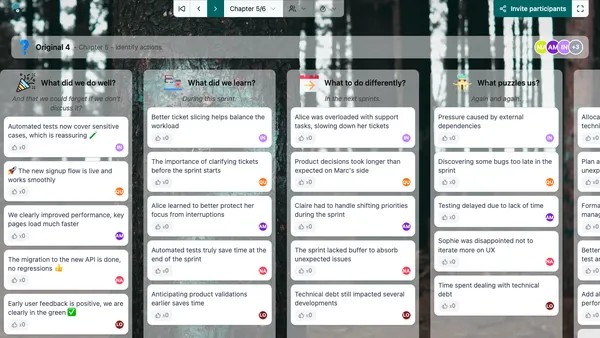

Original 4
Simple and accessible, this retrospective format revolves around the 4 questions that should be asked during a retrospective according to Norman Keth, considered by many to be the inventor of the retrospective.
The **Original 4** format is based on the four fundamental questions proposed by Norman Kerth, widely regarded as one of the pioneers of agile retrospectives. Published in his book *Project Retrospectives: A Handbook for Team Reviews* (2001), these questions form the foundation of many retrospective practices. The four questions are: - **What did we do well?** And that we might forget if we don't discuss it. This highlights positive practices worth preserving. - **What did we learn?** During this sprint. Knowledge gained through experience that the team should retain. - **What should we do differently?** In the next sprints. Concrete changes that could improve the team's effectiveness. - **What still puzzles us?** Questions or concerns that remain unresolved and deserve further investigation. This format is particularly valuable because it balances positive reflection with problem-solving. The fourth question - "What still puzzles us?" - is unique and powerful: it gives space for uncertainties and unanswered questions, encouraging curiosity rather than forcing premature conclusions. Ideal for teams at any maturity level, this format works well as a regular retrospective practice due to its simplicity and depth.
Discover this template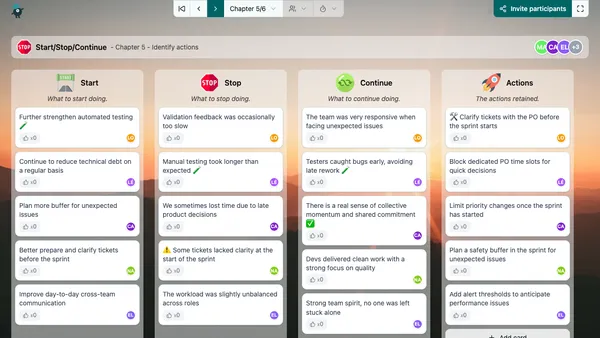

Start/Stop/Continue
This activity offers a very classic retrospective format which remains effective. Based on facts, this retrospective attempts to answer 3 questions: What should we start doing? What should we stop doing? What should we continue to do?
**Start/Stop/Continue** is one of the most classic and enduring retrospective formats in agile methodology. Its strength lies in its simplicity: three straightforward questions that any team can immediately understand and engage with. The format is based on facts and focuses on answering three essential questions: - **Start** 🟢: What should we start doing? New practices, processes, or behaviors that the team believes would be beneficial. - **Stop** 🔴: What should we stop doing? Activities, habits, or processes that aren't working, waste time, or create friction. - **Continue** 🔵: What should we continue doing? Practices that are working well and should be maintained. The beauty of Start/Stop/Continue is that it forces a balanced conversation: the team must identify both things to change and things to preserve. The "Continue" column is often underappreciated but is crucial - it ensures the team doesn't lose sight of what's already working while pursuing improvements. This format is particularly well-suited for: - Teams new to retrospectives, as it's immediately intuitive - Time-constrained sessions, as the structure keeps discussion focused - Regular sprint retrospectives where consistency and simplicity are valued Despite its simplicity, this format remains remarkably effective. The constraint of categorizing every insight into one of three actionable buckets naturally drives the conversation toward concrete outcomes rather than abstract discussion.
Discover this templateReady to run better sprint retrospectives?
Try Umbreon free for 7 days. No credit card, no commitment.
Start free trial