20+ sprint retrospective ideas to energize your teams
Looking for new agile retrospective ideas? Discover our complete guide with over 20 proven sprint retrospective formats used by Scrum Masters worldwide. From timeless classics to the most creative formats.
Start free trialWhy vary your retrospective formats?
The sprint retrospective is one of the pillars of agility. Yet many teams fall into a routine by using the same format every time. The result: participants disengage, feedback becomes superficial, and action items lose their relevance.
Varying your retrospective formats helps maintain team engagement, explore new perspectives, and reinvigorate your agile ceremonies. Each format brings a different angle to analyze the past sprint.
Classic formats
The essentials of agile retrospectives, proven by thousands of teams.
Keep / Drop / Start
The most popular agile retrospective format. The team identifies what to keep doing (Keep), what to stop doing (Drop), and what to start doing (Start). Simple, effective, and easy to facilitate.
Best for beginner teams or when you want a quick, structured retrospective.
Mad / Sad / Glad
This emotion-based format invites each participant to express what made them angry (Mad), sad (Sad), or happy (Glad) during the sprint. It encourages emotional expression and strengthens empathy within the team.
Best when the team needs to open up or after an emotionally charged sprint.
Start / Stop / Continue
Similar to Keep/Drop/Start, this format asks the team what they should start doing (Start), stop doing (Stop), and continue doing (Continue). The emphasis is on concrete action.
Best for action-oriented teams that want immediate results.
4L - Liked / Learned / Lacked / Longed for
This four-dimension format explores what the team liked (Liked), learned (Learned), what was missing (Lacked), and what they wish for (Longed for). It offers deeper reflection than three-column formats.
Best for a more introspective retrospective or at the end of a project.
Starfish
The starfish format offers five categories: More (do more of), Less (do less of), Keep (keep doing), Start (start doing), and Stop (stop doing). This granularity allows for more nuanced feedback than a simple Keep/Drop.
Best when the team wants more detailed and nuanced feedback.
DAKI
Drop / Add / Keep / Improve. This continuous improvement-oriented format asks the team what to drop (Drop), add (Add), keep (Keep), and improve (Improve). An excellent format for mature teams.
Best for experienced teams focused on continuous improvement.
Plus / Delta
The most minimalist format: only two columns. Plus (+) for what worked well and Delta (triangle) for what needs to change. Its simplicity makes it perfect for short retrospectives.
Best for express retrospectives or small teams.
Creative and visual formats
Visual metaphors to stimulate creativity and approach problems from a new angle.
Speed Boat
The team is a boat moving toward a goal. Anchors represent what slows it down, wind what propels it forward, reefs the upcoming risks, and the island the desired destination. A powerful metaphor to visualize team dynamics.
Best for visual teams or when you want to identify blockers and drivers.
Hot Air Balloon
The team travels in a hot air balloon. The fire (what lifts you up), sandbags (what weighs you down), sunny skies (the vision), and storm clouds (the threats). An optimistic format that encourages thinking in terms of opportunities.
Best for boosting team morale or exploring new opportunities.
Sailboat
Similar to Speed Boat, the sailboat adds the crew (team strengths) and compass (direction). Waves represent risks and the anchor represents blockers. A comprehensive format for a 360-degree sprint analysis.
Best for an in-depth retrospective mid-project or at the end.
Rose / Thorn / Bud
Inspired by the garden: roses are successes, thorns are difficulties, and buds are opportunities to nurture. This organic metaphor encourages a balanced view between problems and potential.
Best for teams that want to identify growth opportunities.
Three Little Pigs
Inspired by the fairy tale. The team classifies its practices by solidity: straw house (fragile), wood house (acceptable), or brick house (solid). A fun format to evaluate process robustness.
Best for evaluating the maturity of team practices.
Lean Coffee
No predefined format: participants propose topics, vote to prioritize them, then discuss within a time limit. Democratic and flexible, this format adapts to the team's actual needs.
Best when the team wants to decide the agenda themselves.
Timeline
The team chronologically reconstructs sprint events on a timeline. Each participant adds key moments, positive or negative. This format helps understand the sprint dynamics as a whole.
Best after an eventful sprint or for longer iterations.
Team building and engagement formats
Formats that strengthen team cohesion while collecting valuable feedback.
One Word
Each participant summarizes the sprint in a single word. These words are then shared and discussed collectively. This format breaks the ice and reveals individual perceptions spontaneously.
Best as an icebreaker or for reserved teams.
Team Radar
The team self-evaluates on predefined axes (communication, quality, collaboration, velocity, etc.) by placing scores on a radar chart. Comparison over time shows progression.
Best for measuring team progress across multiple sprints.
Mood Board
Participants choose images, GIFs, or emojis that represent how they felt during the sprint. This visual and fun format unlocks creativity and allows freer expression than words alone.
Best for creative teams or when you want a radical format change.
Kudos Wall
A recognition wall where each participant thanks a colleague for their contribution during the sprint. This format strengthens bonds and highlights individual efforts within the team.
Best for strengthening team cohesion and celebrating achievements.
Six Thinking Hats
Based on Edward de Bono's method, each "hat" represents a thinking mode: facts (white), emotions (red), risks (black), opportunities (yellow), creativity (green), and organization (blue). The team examines the sprint from each angle.
Best for a structured and comprehensive sprint analysis.
World Cafe
The team splits into small groups that rotate between different discussion "tables", each with a theme. Ideas get enriched with each rotation. A participative and dynamic format for larger teams.
Best for large teams (8+ people) or cross-team retrospectives.
Energy Levels
Each participant indicates their energy level throughout the sprint on a timeline graph. Peaks and valleys reveal moments of motivation and fatigue, helping the team better manage its pace.
Best for detecting signs of burnout or overload within the team.
How to choose the right retrospective format?
Adapt to your team
Beginner teams will appreciate simple formats (Keep/Drop/Start, Plus/Delta). Mature teams can explore more complex formats (Six Thinking Hats, DAKI).
Vary the formats
Alternate between classic, visual, and fun formats. Variety maintains engagement and offers new perspectives each sprint.
Consider the context
After a tough sprint, go for an emotional format (Mad/Sad/Glad). To celebrate a win, try a Kudos Wall. Match the format to the team's experience.
Respect the time
Simple formats (Plus/Delta, One Word) suit short retrospectives (30 min). Complex formats (World Cafe, Six Thinking Hats) need more time (1h+).
Try these formats on Umbreon
All our retrospective templates are guided step by step with a built-in timer, votes, and exports. Pick a format and launch your next retrospective.
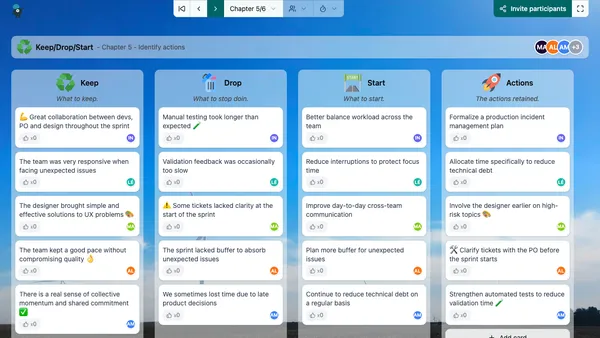

Keep/Drop/Start
In this classic retrospective format, participants must reflect on what to keep (keep), what to stop doing (drop) and what to start doing (start) for the next sprint.
Discover this template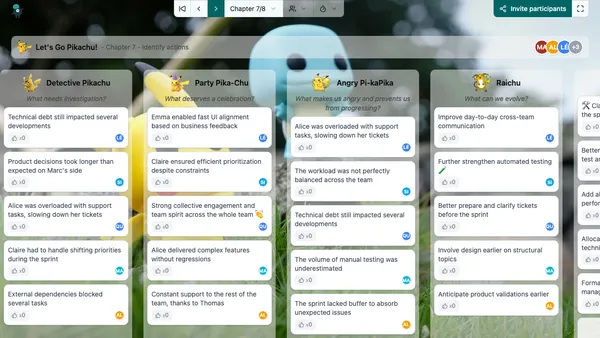

Let's Go Pikachu!
A fun Pokemon-themed retrospective to catch insights and evolve your team
Discover this template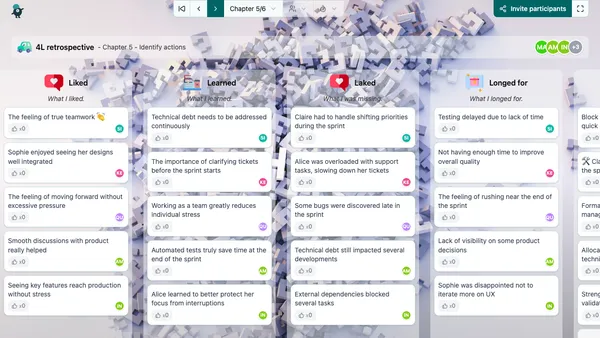

4L retrospective
The "4L" retrospective is a popular format that produces significant results for many teams. Here, 4 columns are displayed at the start of the activity and allow participants to reflect on what went well and what can be improved in the sprint.
Discover this template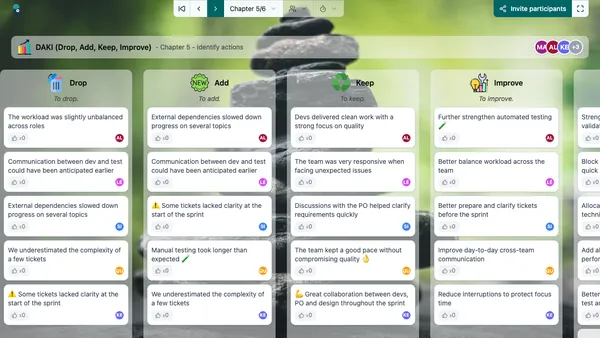

DAKI (Drop, Add, Keep, Improve)
DAKI is a classic retrospective format that fosters reflection on team practices and values. This format is recommended after the team has practiced scrum for several sprints. The team will then be better able to propose relevant changes.
Discover this template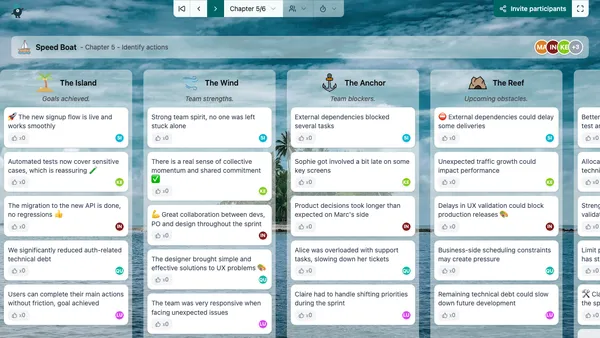

Speed Boat
One of the most popular retrospective formats. First published by Luke Hofmann in 2006 with the book Innovation Games: Creating Breakthrough Products Through Collaborative Play.
Discover this template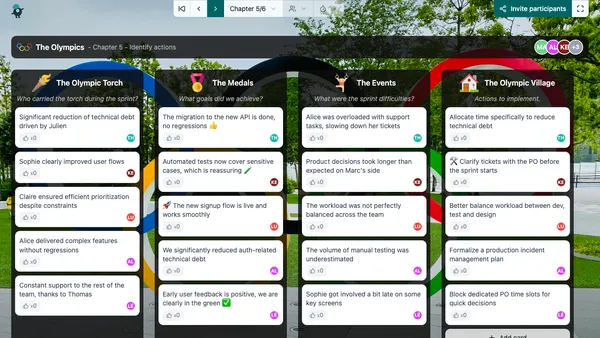

The Olympics
An ideal retrospective during the Summer or Winter Olympics. In this format, participants will use Olympic symbols to identify new improvement areas.
Discover this template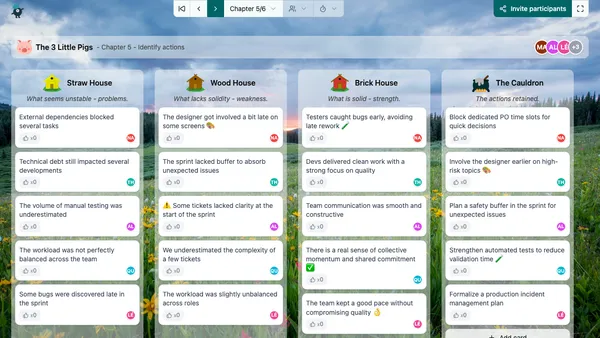

The 3 Little Pigs
Through the story of the 3 little pigs, participants will analyze the team's fundamentals to make them more solid.
Discover this template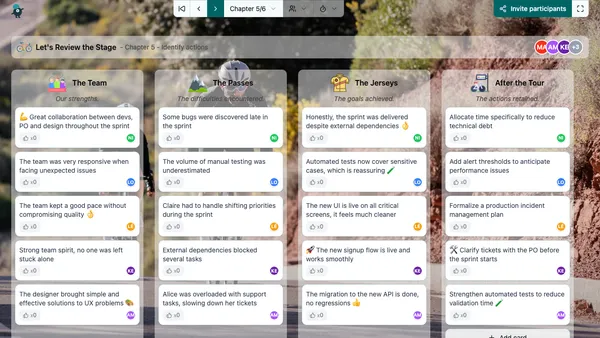

Let's Review the Stage
Cycling-themed retrospective. The team just crossed the finish line of today's stage (their sprint). It's time to take stock and prepare for the next stage.
Discover this template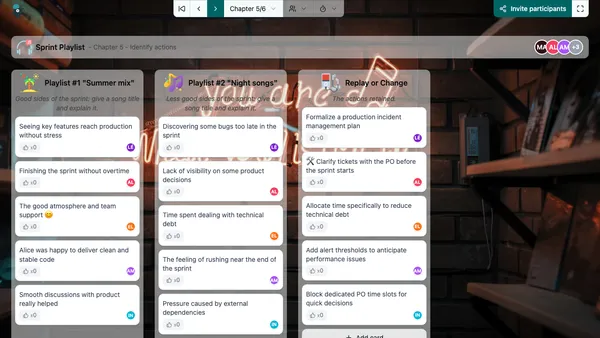

Sprint Playlist
In this original retrospective, participants will create the sprint's playlist. An ideal format to animate summer retrospectives.
Discover this templateFrequently asked questions
What is the best sprint retrospective idea for beginners?
How often should you change retrospective formats?
How long should a sprint retrospective take?
How to run a retrospective with a distributed team?
Can you combine multiple retrospective formats?
What to do if the team doesn't actively participate in the retrospective?
What are the most popular retrospective formats in 2025?
Ready to run better sprint retrospectives?
Try Umbreon free for 7 days. No credit card, no commitment.
Start free trial